Showing posts with label many-to-many. Show all posts

Wednesday, April 1, 2009

The most comments I ever got on Facebook ever.

I meant to post about this a few weeks ago when I did it, but something fascinating happened when I posted a simple question to my Facebook profile in the form of a "note."

A bizarre chain of discussions surrounding the "double space" has prompted me to inquire further. Here's the question: do you put two spaces after a sentence ends when you are typing? What is the standard?

Some say yes, some say no. I want proof. Give me citations. Chicago, MLA, AP style, tell me what you know.
I "tagged" about twenty people in the note who work across a variety of fields: journalists, copy-editors, professors, poets, administrative assistants, college students, the list goes on. It was like opening a floodgate. A remarkable twenty-one responses came in within a little more than twenty-four hours. People were unbelievably passionate about the debate. And I will tell you that there is absolutely no agreement on the subject. I myself am sticking with the double-space.

But I did have fun tagging one of my bosses at work who vehemently disagrees with me. To the point that he recently removed every double space in a piece that I sent his way. (Which is actually what prompted me to post the question in the first place). I told him that I was now "crowdsourcing" grammar and style. It's the wave of the future...

Here are some of the best replies...

Aaron:
One thing I find interesting though is that often my extra spaces are removed automatically. Such is the case in the comments I'm posting right here. Facebook apparently disagrees with my assessment.

I find this highly annoying. I believe that formatting greatly affects the power of written communication. Therefore, every effort should be made to preserve the formatting choices of the author, regardless of medium and venue. Furthermore, I think any website offering space for written publication (like this one) should necessarily include functionality for standard formatting options such as bold and italic, which is quite simple in the age of html.

As it stands now, we never know which sites are going to recognize our html formatting and which ones won't. So often times we look like idiots for writing something like this....
Ashley:
if you're writing a paper for school, two spaces. if you're writing anything else in the whole world, one space. i'm a goddamn copy editor. xo
Jennifer:
I was always told that in publishing and journalism it is one space to not take up much needed characters and space with excess space. I know in texting everyone seems to be moving to the single space to avoid using up characters. But for proper letters and clarity I find the two space much needed.


Craig:
One space. One space. One space. It's the 21st century. And yet I still capitalize Web. ... (Don't get me started on the proper spacing around ellipses.)


Fred:
Pick up any contemporary book -- I just glanced at The Omnivore's Dilemma -- and you'll find a single space after the period. To my eye, the additional bit of space looks funny. (And I was taught to type in the 80s on an actual typewriter when the two-space rule was still very much in effect. It was only years later that I actually looked at how it... Read More was done in well-designed books and magazines that I decided to forgo the additional space. In short, I trust the designers of contemporary books and magazines more than my crusty old typing teacher.)

If nothing else, I like to believe that all those saved spaces are forestalling the onset of carpal tunnel.


Tuesday, March 24, 2009

To Tweet and be ReTweeted...


I have been using Twitter since the summer of 2008. I think that I joined because everyone else in my office started using it on the same weekend -- the weekend that our organization threw a massive conference in the Midwest that drew over 3,500 participants. Twitter was one of the many social media sites that conference goers were using to interact with each other and the outside world at the event. I remember the first few months being rather useless. I never went to the website (why would I?) and therefore never updated. Because I never visited it, I never saw what the people I was "following" were saying. I couldn't really see the point.

Later in the summer I read Clay Shirky's book Organizing Without Organizations and decided to give Twitter another shot. This time, I decided I would use it as a social tool for real life and I posted updates like "headed to the dirty" (read: the Dirty Truth, a bar in downtown Northampton) or "anyone wanna go to the show at the elevens tonight?" It was about at this time that I discovered the great advantages to syncing my phone number with Twitter. Within a few seconds I was suddenly able to send text messages to "40404" and sound off about anything.

But posting in the social media sphere is like bringing up the old kōan "if a tree falls in the forest and no one hears it, does it make a sound?" Tweeting in the forest silently was pointless. Because I couldn't see what others were saying I completely lacked the validation that comes from using social media. I needed to experience what 140-character statements my friends were saying. And I needed to be sure that my "followers" were enjoying my contributions. In short, I needed interactivity.

In the last three months my use of Twitter has increased dramatically. I've tried syncing it to my Facebook status and mobile Tweeting, but the ultimate reward was installing an application that allowed me to see what the folks I was "following" were saying. TwitterFox was a game changer because it gave me the window to interactivity that I needed to make using Twitter at all worthwhile.

I follow an interesting crew of folks. Mostly activists, journalists, and information aggregators, nearly every Tweet I read has a link in it. I realized the other day that during this time when I am in still juggling full-time work and finishing up school there are many days where all the news I read is the news I get through my collegaues reports and the news aggregators I subscribe to.

There's an overwhelming amount of information out there. And it just makes me wonder still if the role of journalist is shifting into information facilitator. Someone speaking at a conference I went to recently put it quick succintly: The "who, what, when, where" is easy enough for anyone to find. But the why? That's where we need journalists most.

Tuesday, February 24, 2009

Tweeting the NSOTU


Photo courtesy of -nathan via Flickr and Creative Commons

Some anecdotal observations from "watching" Obama's address to the nation this evening.

I'm not new to a multimedia, multi-platformed, swithtasking approach to watching major moments in political television. I gathered friends over for nearly every last debate (back when no one really knew a lot about Mike Gravel other than the fact that he had one of the oddest and most humorous online videos in presidential candidate history) and dealt with the span of their reactions to my insistance that I have a laptop in front of me and a Twitter feed ticking by.

Back then, barely a year ago, I found it difficult to keep up. I would be reading a Tweet, trying to listen to a friend's comment, and pay attention to what the candidates were actually saying all at the same time. Maybe it was just being a late adopter, but it was hard to keep up.

Tonight however it was like second nature. I saw a post come up in my Twitter aggregator (TwitterFox -- which throws it into a manageable add-on for my Firefox browser) with a simple tag: #NSOTU. It took me less than a full second to realize that was the tag for tonight's speech (read: Not State of the Union). Before President Obama was even a few minutes into the speech, someone posted a link to the full text of his speech. So in addition to listening to the commentary of the people in the room, reading the Tweets, paying attention to the visual images on my television and listening to Obama speak, I was reading along.

It was hard to keep up, with about 50 new posts per minute requesting my browser to refresh itself. A lot of the comments made it feel like I was sitting in a much larger living room with a bigger group of friends. In other words, a lot of commentary was focused on how fast Pelosi rose to her feet or placing bets on when we would finally hear the phrase "clean coal."

But occaisionally there was a spark of deliberation. And though it seemed a mere speck in a large mine of banality, someone would inevitably catch it and react. So small pockets of conversation were flittering around and I saw as voyeour -- all the while keeping to myself but reading along.

Changing landscapes


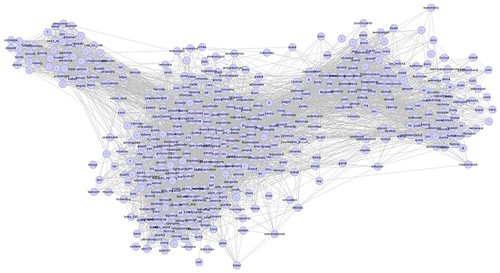
Image of FlickrLand (Flickr's social network) from GustavoG via Flickr and Creative Commons

Though Wahl-Jorgensen's book is rather dry and academic, I honestly find the content fascinating. And thanks to my many years in academia, I appreciate the endlessly annotated nature of the writing, even if its coming in my least favorite to read format of parenthetical notations. However any attempt to discuss any aspect of the journalism industry seems somehow dramatically outdated when compared to the reality of the current newspaper crisis. With reports as high as 15,000+ jobs lost for journalists in 2008, the landscape for journalism has been so dramatically impacted that it can be difficult to stay focused on an assessment that doesn't take these changes into account.

Lately I've been agreeing with thinking about journalism in a new frame. With so much information at our fingertips, it is possible that the role of the journalist is changing from information provider to discussion facilitator. Wahl-Jorgensen's placement of letters to the editor next to other forms of "mediated participation" falls short in today's world of Twitter and viral social networks. The idea of radio call-in programs or television talk shows as an advanced state of participation seems distant.

But the real difference is not simply how many more ways there are to participate, it is in how we define participation. Ultimately it is important to keep one distinction in mind: those old formats relied on a gatekeeper to control access to the audience. With platforms on the Internet everyone gets a shot, everyone gets a microphone, and everyone can get an audience. Moderated comments on a newspaper article or website may control some of the conversation, but for each location it is restricted in it can move to dozens of other un-mediated locations.