Showing posts with label journalism. Show all posts
Showing posts with label journalism. Show all posts
Wednesday, April 1, 2009
The call-in assignment...

Okay. The radio assignment.
I tried. I did try. I spent a good 45 minutes listening to the Thom Hartmann show on WHMP. I caught him with a guest who was talking about global economics and as interesting as the topic was I didn't really have anything to contribute. So I waited for a new guest. And on came some woman who had written a book about whiteness and race and I thought to myself, "okay, this I can handle. I will call and ask a question about those people who believe that racism is now over in America because we elected Obama over McCain." (In case you are wondering, I think that people who believe that are incredibly unaware of racial issues in America and the reductive ignorance of a statement like that pretty much terrifies me).
So I dialed. And I was expecting to be put on hold or to reach an automated "press one for live questions" menu. Instead, a woman answered the phone directly. And then my brain and mouth launched into a debate with each other. Uh, why am I doing this? What is the point of my call? Do I care more about getting a good grade on this assignment or about making a valuable contribution to this conversation?
Instead of asking her if I could go on the air, I asked her if the show was pre-recorded or live. (Honestly, I was curious). She said it was always live. I paused for a moment and considered my options. And then I thanked her and hung up the phone.
I will be the first to admit that there's a lot of irony to my reaction. I can elaborate on this more in class, but suffice it to say that I've got a long history with radio and spend a lot of my time preaching the greatness of it as a medium. And don't get me wrong, I still think radio is amazing. Radio is one of the best communication tools we have -- it is a one-time investment that can keep us connected to news and culture with no additional cost. But as I sat on the phone with the woman who answered my call I realized that the entire root of my motivation was this assignment. I didn't want to ask a question just for the sake of doing it. I was just going through the motions. And that sort of empty interaction is not going to elevate the discourse on anything. So I hung up.
I've decided to take this assignment in stride as a sort of conscientious objector. Now don't get me wrong, had I taken the time to consume talk radio non-stop for the past few weeks I am absolutely positive I could have found a discussion going on that I actually wanted to participate in. And for that, I recognize that the reason I was unable to really complete the assignment is partially based on poor time management. (In all honesty, my thesis is due in ten days and I work about 50 hours a week on top of taking this class…excuses, excuses, I know). But after going through the forced motions of the LTE assignment, I just couldn't bring myself to do it again.
So let me instead close by going into some detail about why I think elevating the discourse is important enough for me to refuse to complete the assignment. I considered calling in to a program that played music to sound off about the host’s choices. But as I pointed out in my last post, that is not journalism. That’s cultural critique, it’s opinion, but it’s not reporting. My opinion on whether the music is any good, or on the things one should consider before adopting a pet from the pound (another fabulous program running on AM talk radio this morning), or even me calling in to Rush’s show to tell him that I can’t stand him and feel he is a symbol for everything that is wrong with America today – none of it is journalism.
If we re-frame this class as one on the role of interactivity in an emerging digital media space and its impact on culture, politics, and democracy then I would have a completely different take on this entire thing. Because all of these elements, from LTEs to talk radio to restaurant reviews to Twitter are all impacting culture, politics, and democracy. But that doesn’t mean they are journalism. And framing it that way has me asking the following: at what point did the lines completely blur between reporting and commentary?
I’m the first to say that when dealing in definitions about journalists and journalism we are confronting an important issue that is both nuanced and complex. This whole landscape of “citizen journalism” (a term that is immensely problematic) directly challenges a lot of the established and accepted definitions of what defines a journalist.
But that’s exactly it. I don’t know if the definition of a journalist is necessarily as important as the definition of journalism.

Talk Radio, part II. (play vs film)
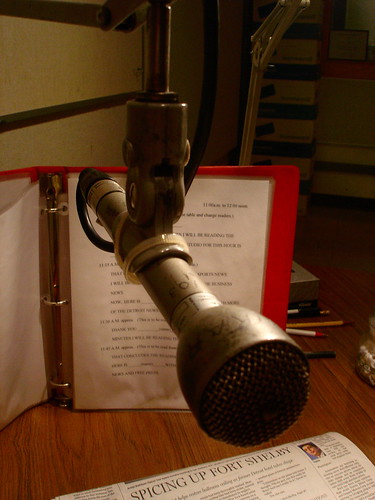
Scott and I got into a fun little debate over Bogosian's Talk Radio last week. Since he has asked us to post a blog comparing the play and the film, I am copping out slightly by re-posting my most recent response to our conversation (which covers my thoughts on the comparison). The only thing I have to add that is not included below is that I think Eric Bogosian might actually secretly be Anthony Bourdain. Anyone else see the similarity?
Back to the matters at hand. Here is my latest rant. Feel free to join in...
I'm not arguing against talk radio as an institution for meaning-making. On that nice, academic scaffolding we can legitimize talk radio's existence. But I wouldn't make the argument that talk radio is journalism. Or, to be fair, not the talk radio featured in the play. Sounding off is not journalism. Sounding off is entertainment. Journalism holds those in power accountable. I'm not arguing that talk radio can't. I would argue that Bogosian's macho-rebellious cool cat is off on a personal philosophic journey. It has value, but it's not journalism.
Talk radio, as we know it today, has its own sordid history in the United States. Bogosian may have written the play in mid-1980s, but being just a young toddler myself in the grand decade of neon and new wave, all I can really hear is a Rush Limbaugh or a Sean Hannity. And though the rise of the right-wing conservative talk radio is often related to the repeal of the Fairness Doctrine, it was really the 1996 Telecommunications Act -- which repealed ownership limits on radio stations -- that turned the local downtown station into a repeater tower for the nationally syndicated ideology of the right-wing. Which returns me to the whole idea of gatekeeping and meaning-making. It was pretty easy for U.S. politics to turn to the right when talking heads who were cheaper to syndicate than paying for local reporters and investigative journalism.
After watching the film (and I presume that Bogosian oversaw screenplay and had his hand in direction as well) it just becomes more clear that this is about the one-man's libertarian journey for meaning and not about the institution itself.
And fun as it is, it sure ain't about journalism...
Tuesday, March 24, 2009
To Tweet and be ReTweeted...
I have been using Twitter since the summer of 2008. I think that I joined because everyone else in my office started using it on the same weekend -- the weekend that our organization threw a massive conference in the Midwest that drew over 3,500 participants. Twitter was one of the many social media sites that conference goers were using to interact with each other and the outside world at the event. I remember the first few months being rather useless. I never went to the website (why would I?) and therefore never updated. Because I never visited it, I never saw what the people I was "following" were saying. I couldn't really see the point.
Later in the summer I read Clay Shirky's book Organizing Without Organizations and decided to give Twitter another shot. This time, I decided I would use it as a social tool for real life and I posted updates like "headed to the dirty" (read: the Dirty Truth, a bar in downtown Northampton) or "anyone wanna go to the show at the elevens tonight?" It was about at this time that I discovered the great advantages to syncing my phone number with Twitter. Within a few seconds I was suddenly able to send text messages to "40404" and sound off about anything.
But posting in the social media sphere is like bringing up the old kōan "if a tree falls in the forest and no one hears it, does it make a sound?" Tweeting in the forest silently was pointless. Because I couldn't see what others were saying I completely lacked the validation that comes from using social media. I needed to experience what 140-character statements my friends were saying. And I needed to be sure that my "followers" were enjoying my contributions. In short, I needed interactivity.
In the last three months my use of Twitter has increased dramatically. I've tried syncing it to my Facebook status and mobile Tweeting, but the ultimate reward was installing an application that allowed me to see what the folks I was "following" were saying. TwitterFox was a game changer because it gave me the window to interactivity that I needed to make using Twitter at all worthwhile.
I follow an interesting crew of folks. Mostly activists, journalists, and information aggregators, nearly every Tweet I read has a link in it. I realized the other day that during this time when I am in still juggling full-time work and finishing up school there are many days where all the news I read is the news I get through my collegaues reports and the news aggregators I subscribe to.
There's an overwhelming amount of information out there. And it just makes me wonder still if the role of journalist is shifting into information facilitator. Someone speaking at a conference I went to recently put it quick succintly: The "who, what, when, where" is easy enough for anyone to find. But the why? That's where we need journalists most.
Tuesday, February 10, 2009
Bill Keller and the future of news(papers)
 (Photo courtesy of Just.Luc via Creative Commons/Flickr)
New York Times executive editor, Bill Keller, made a lengthy "column" out of responding to readers comments and questions on their website last week. The first series of questions delved into some of the big issues facing journalism today -- including what will happen to newspapers in the near future with so much media consumption moving online.
I can see two threads that must be identified here when discussing the "newspaper crisis." One deals with the user's choice of format. Dramatic shifts in media consumption from the printed to the web page can be identified, but they are only part of the story. People still consume traditional (print, broadcast) media at a rapid pace and the websites visited for news online are predominantly the same established brands. And with millions of people in America living without access to affordable high-speed Internet, these trends shouldn't come as too big a surprise.
The second is paying for content and journalists. Commercial media is starting to collapse under the weight of its behemoth holdings. The rampant consolidation that escalated dramatically in the mid 1990s -- allowing companies to continue buying more outlets across mediums and in the same markets -- have bared the brunt of such cost-cutting measures as slashing reporters' jobs in order to maintain the bottom line. It is far cheaper to produce weather, sports, or entertainment pieces than it is to pay journalists to do investigative reporting. The foreign bureaus began to close. Reporters were asked to fill the roles of news anchors instead of writers.
It is possible that the commercial model can't continue to service the public need for reporting in this country. But this could signal tremendous opportunity. The ideas and concepts can be seen throughout the myriad of proposals popping up across the field itself. From establishing a National Endowment for Journalism, to micro-payments for content by the user, to the television tax model used by the BBC across the pond, the discussion about driving a wedge between the co-dependent relationship of advertising and reporting is getting louder.
And if all else fails, we could always go for the flavored ink model.
Subscribe to:
Posts (Atom)